Filter by

Dunia Ilmu Pengetahuan Alam dan Sosial untuk Kelas VI SD dan MI, Pendamping B…
As a premier companion text, this book moves aggressively beyond raw thematic reading. Recognizing that Grade 6 serves as a stepping stone to secondary school, the textbook utilizes a deep learning methodology structurally organized around two core assessment frameworks: AKM (Asesmen Kompetensi Minimum): Every unit trains students to tackle national assessment benchmarks. Rather than prompti…
- Edition
- -
- ISBN/ISSN
- -
- Collation
- -
- Series Title
- -
- Call Number
- 2.507.0142.C.R

Dunia Ilmu Pengetahuan Alam dan Sosial untuk Kelas V SD dan MI, Pendamping Bu…
Unlike the standard primary textbook that introduces raw scientific and social concepts, this companion workbook focuses heavily on cognitive acceleration. It shifts the learning focus from basic comprehension to advanced critical thinking by deeply integrating two modern educational frameworks: AKM (Asesmen Kompetensi Minimum): The exercises are meticulously modeled after the Indonesian Nat…
- Edition
- -
- ISBN/ISSN
- -
- Collation
- -
- Series Title
- -
- Call Number
- 2.507.0141.C.R

Easy Steps to Chinese for Kids 1B Textbook
Book 1B maintains the series' core philosophy of "joyful learning" through songs, rhymes, and pictures. It provides a smooth learning curve for children who have just mastered counting to 10 and basic greetings, ensuring they don't feel overwhelmed as the vocabulary grows. The textbook shifts toward helping children describe things. Instead of just naming an object, students learn to talk ab…
- Edition
- -
- ISBN/ISSN
- -
- Collation
- -
- Series Title
- -
- Call Number
- 2.495.1.0011.C.R

Easy Steps to Chinese for Kids 1A Textbook
The core philosophy behind Volume 1A is "learning through play." Recognizing that Mandarin tones and characters can feel completely foreign to young children, the textbook prioritizes auditory and oral familiarity. It follows a natural, stress-free progression that matches how young children acquire language. Instead of presenting long grammar tables, the book uses beautifully illustrated ca…
- Edition
- -
- ISBN/ISSN
- -
- Collation
- -
- Series Title
- -
- Call Number
- 2.495.1.0010.C.R

Easy Steps to Chinese for Kids 3A Textbook
The core philosophy of Easy Steps to Chinese for Kids is to make Mandarin accessible, intuitive, and stress-free. Recognizing that Chinese characters can be intimidating for young children, the textbook utilizes a communicative approach combined with visual and auditory triggers. Level 3A shifts the learning focus toward expanding vocabulary and developing basic conversational fluency. Rathe…
- Edition
- -
- ISBN/ISSN
- -
- Collation
- -
- Series Title
- -
- Call Number
- 2.495.1.0004.C.R

IPAS 3 Ilmu Pengetahhuan Alam dan Sosial SD/MI Kelas III Kurikulum Merdeka
Instead of isolating scientific data from cultural or historical topics, this textbook explores how human communities and the natural world constantly shape one another. The book relies heavily on an active, experiential learning model. Students are guided by a recurring set of interactive characters to explore "Essential Questions" (Pertanyaan Esensial) at the start of every lesson. Rather …
- Edition
- -
- ISBN/ISSN
- -
- Collation
- -
- Series Title
- -
- Call Number
- 2.507.0137.C.R

Matematika 3 SD/MI Kelas III Kurikulum Merdeka
The core philosophy of this Kurikulum Merdeka textbook is encapsulated in its prominent series subtitle: "Belajar Bersama Temanmu" (Learning with Your Friends). It treats mathematics not as a rigid set of instructions to memorize, but as an interactive, conversational tool used to navigate the modern digital world. Instead of traditional rote learning drills, the book utilizes a highly colla…
- Edition
- -
- ISBN/ISSN
- -
- Collation
- -
- Series Title
- -
- Call Number
- 2.510.0171.C.R
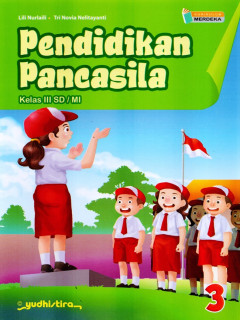
Pendidikan Pancasila Kelas III SD/MI 3 Kurikulum Merdeka
The book teaches citizenship through immersive, daily-life scenarios that relate directly to an eight-year-old child's world. Moving away from rigid rote learning, it is built entirely around interactive classroom activities, including communal singing (bernyanyi), role-playing (bermain peran), group storytelling (bercerita), and hands-on mini-projects (proyek mini). The book embraces the ho…
- Edition
- -
- ISBN/ISSN
- -
- Collation
- -
- Series Title
- -
- Call Number
- 2.323.6.0039.C.R
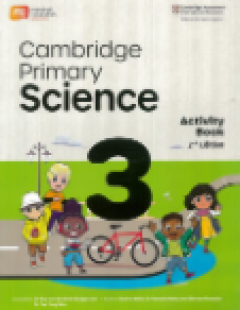
Cambridge Primary Science 3 Activity Book 2nd Edition
While the Learner's Book focuses on introducing big ideas and guiding students through hands-on experiments, the Workbook is where students learn to document, analyze, and process what they have discovered. It focuses heavily on developing Thinking and Working Scientifically (TWS) skills—teaching children how to properly record data, spot patterns, make predictions, and draw logical conclusio…
- Edition
- -
- ISBN/ISSN
- -
- Collation
- -
- Series Title
- -
- Call Number
- 2.507.0132.C.R
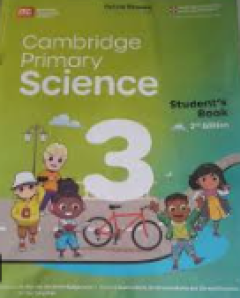
Cambridge Primary Science 3 Student's Book 2nd Edition
The core philosophy of the 2nd Edition revolves around the Thinking and Working Scientifically (TWS) framework. Right from the opening pages, the book moves away from passive reading and introduces students to the five primary types of scientific inquiry: research, fair testing, observing over time, pattern seeking, and identifying and classifying. Every chapter is packed with vivid, colorful …
- Edition
- -
- ISBN/ISSN
- -
- Collation
- -
- Series Title
- -
- Call Number
- 2.507.0132.C.R
 Computer Science, Information & General Works
  Philosophy & Psychology
  Religion
  Social Sciences
  Language
  Pure Science
  Applied Sciences
  Art & Recreation
  Literature
  History & Geography